How to Know If Your Garage Door Cables Are Worn Out in Nashville TN
Most Nashville homeowners never look at their garage door cables until something goes wrong. The door stops working. The car is stuck inside. And the repair bill is bigger than it needed to be because the warning signs were there for weeks and nobody caught them. Here is the good news. Worn garage door cables Nashville TN homeowners are dealing with right now almost always give clear signals before they snap completely.
The problem is knowing what those signals look like. Once you know, you can catch a failing cable early, schedule a repair on your own schedule, and avoid the emergency call that always seems to happen at the worst possible time. If something on this list already matches what you are seeing on your door right now, stop reading and Call (615) 706-3471) for same day service across Nashville and the surrounding Middle Tennessee area.
What Garage Door Cables Do and Why They Matter So Much
Before the warning signs make sense, you need to understand what the cable is actually doing every time your door moves. Your garage door is heavy. A standard two car insulated door in a Nashville home weighs anywhere from 150 to 300 pounds depending on the material and style. The torsion spring mounted above the door stores the mechanical energy needed to counterbalance that weight, but the spring does not connect directly to the door panels.
The cable is the link between the spring and the door. Lift cables are galvanized steel cables that run from a bracket at the very bottom corner of the door, up through a pulley or around a cable drum on the torsion shaft above. When the spring unwinds as the door opens, the rotational energy travels through the cable drums and down through the cables, lifting the door panels smoothly up the tracks.
When the door closes, the cables wind back onto the drum as the spring stores energy again for the next cycle. This happens every single time you press that button. Four times a day, eight times a day, more if your household uses the garage as the main entrance. Year after year. The cables are working constantly, and like anything that works that hard for that long, they eventually show signs of wear before they fail completely.
Warning Sign 1: The Door Rises Unevenly or Tilts to One Side
This is the most visible early warning sign and one of the easiest to spot if you know to look for it. Stand inside your garage and watch the door the next time it opens.
A healthy cable system means both sides of the door rise at exactly the same rate, smooth and level from the bottom all the way to the top. If one side comes up faster than the other, or if the door appears slightly tilted during travel, the cable tension is unequal between the two sides.
Unequal tension almost always means one cable has stretched more than the other, developed partial strand failure inside the galvanized wire, or is beginning to fray at a connection point.
The door looks like it is working but it is quietly putting asymmetric stress on the track hardware, rollers, and the remaining good cable with every single cycle.
Left alone, that imbalance gets worse over time and the weaker cable gets closer to a full snap with every use.
This is the kind of thing most Nashville homeowners notice and then forget about because the door still opens. Do not forget about it. An uneven door is a cable that is telling you something is wrong.
Warning Sign 2: You Can See Fraying on the Cable
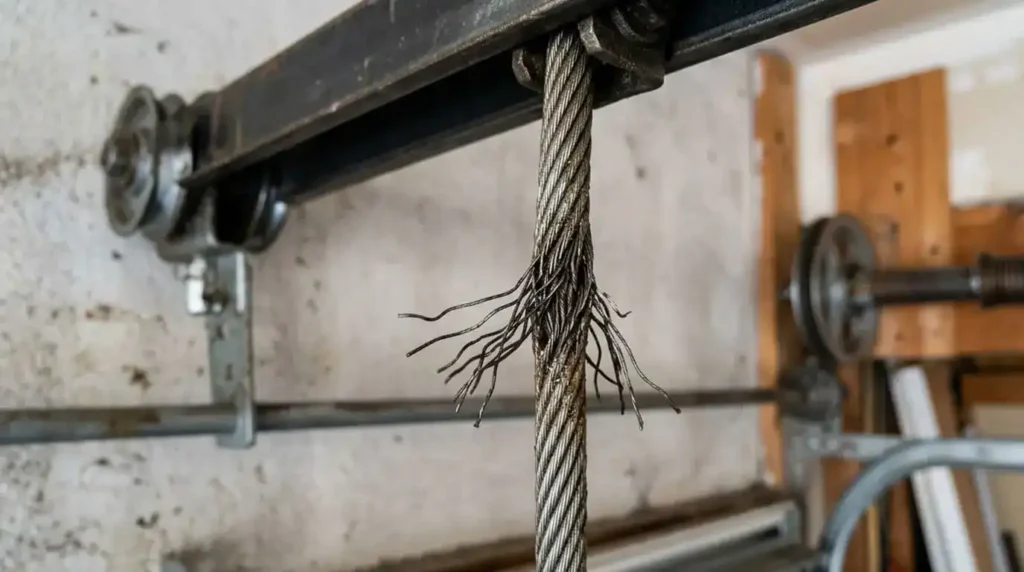
Look at your cables directly. You do not need tools or technical knowledge for this. Just your eyes and thirty seconds. Garage door lift cables are made of multiple individual steel strands wound tightly together, similar in concept to a rope but made of metal. When the cable begins to wear out, individual strands start to break one at a time.
At the point of strand failure, those broken wires separate slightly from the main cable body and stick outward, creating a fuzzy, bristly, or frayed appearance at that spot. Fraying is not a cosmetic issue. Each broken strand is one less strand carrying the load of the door. As more strands break, the remaining intact strands are each carrying more tension than they were designed to handle, which accelerates the failure of those strands too.
A cable that is visibly fraying at any point along its length is a cable in the process of failing. It is not a matter of whether it will snap. It is a matter of when. Check the cable from the bottom bracket at the corner of the door up to where it meets the drum above.
The bottom bracket connection point and the drum groove are the two areas where fraying tends to appear first because those are the spots where the cable experiences the most concentrated bending stress on every cycle. If you see fraying anywhere on the cable, call a technician before the next time you use the door. A frayed cable can complete its failure on the very next cycle.
Warning Sign 3: Rust or Dark Discoloration Along the Cable
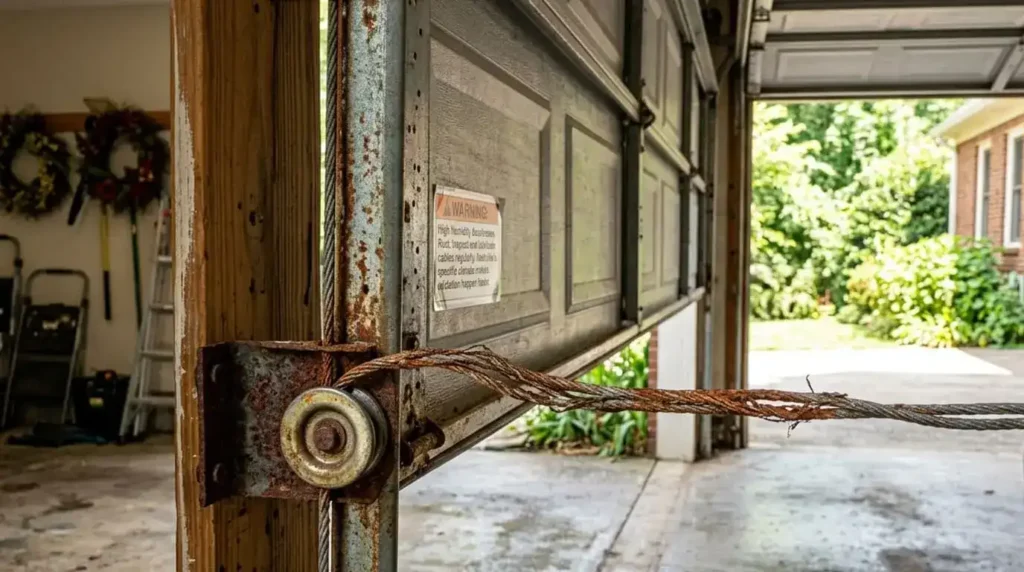
Nashville sits in a humid subtropical climate. Davidson County sees significant rainfall every year, and the heat and humidity that define Middle Tennessee summers create an environment where unprotected steel corrodes faster than people expect. Garage door cables that are not lubricated regularly develop surface oxidation from moisture exposure.
This shows up as rust colored staining, dark discoloration, or a rough texture along the cable surface that was not there when the cable was new. In unventilated attached garages across Nashville, Antioch, Brentwood, and the surrounding communities, cables can develop meaningful surface rust within a few seasons of going without lubrication.
Surface rust that wipes away with a cloth and some lubricant is a maintenance issue you can address. But rust that has pitted into the surface of the cable, creating small craters or rough patches in the metal, has eaten into the structural steel of the individual strands. At those pitted points, the cable is thinner than it was designed to be and cannot carry the rated load.
This is not something lubrication fixes. The cable needs to come out. Look for any discoloration or rough texture along the full visible length of both cables. Light surface staining is manageable. Anything that looks like the rust has bitten into the metal deserves a professional eye immediately.
Warning Sign 4: The Cable Has Jumped Off the Drum
The cable drum is a grooved spool mounted on the torsion shaft above the door. The cable winds and unwinds in that groove on every cycle, and the groove keeps the cable tracking properly so it applies even tension during the door’s travel. Sometimes the cable slips out of the drum groove and sits wrapped loosely or incorrectly around the drum instead.
When this happens the door behaves very similarly to a snapped cable. One side drops or hangs lower than the other. The door will not travel smoothly. The opener may strain or trigger its overload protection. From a distance it can look like the cable broke, but the cable itself is still intact. It just lost its proper path on the drum. A cable that has jumped the drum groove needs immediate attention.
Operating the door in that condition puts the full load on the misrouted cable in a configuration it was not designed for, which either snaps the cable or warps the drum groove, or sometimes both. Either outcome turns what should have been a simple re routing job into a cable replacement plus drum replacement on the same visit. If your door dropped suddenly on one side and you can see cable sitting loosely near the drum rather than cleanly wound in the groove, stop using the door and call a technician.
Warning Sign 5: The Opener Is Struggling or Straining
Your garage door opener motor was calibrated to lift a door that is properly counterbalanced by a healthy spring and carried by two intact cables sharing the load equally. When the cables wear out and lose integrity, the effective load on the opener increases even though the door weight has not changed. A cable that has developed partial strand failure is slightly less effective at transferring the spring energy to the door than a healthy cable.
The opener compensates by working harder. This shows up as a motor sound that seems more strained than it used to, a door that opens more slowly than it did previously, or an opener that occasionally reverses mid cycle because its internal overload sensor detected it was pulling more than it should be. Nashville homeowners in this situation often assume the opener motor is failing and start shopping for a replacement unit, when the actual underlying cause is cable wear.
If your LiftMaster, Chamberlain, or Genie opener has been working fine for years and recently started struggling without any other obvious cause, inspect the cables before you buy a new motor. The opener is usually fine. The cables are usually the story. Call (615) 706-3471) if your opener is behaving differently than it used to. We diagnose the full system, not just the part that is making noise.
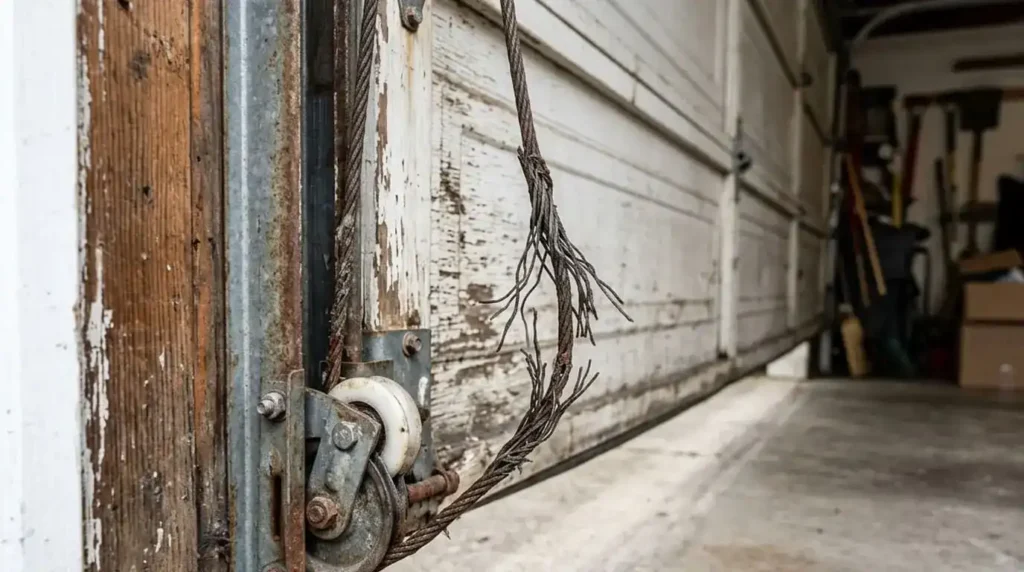
Warning Sign 6: Loose Cable Hanging Inside the Garage
This one is hard to miss. If you see a cable hanging slack or coiled loosely inside the garage near the door, it has either snapped completely or detached from its anchor point at the bottom bracket. The bottom bracket is a metal fitting bolted to the very bottom corner of the door panel on each side. The cable attaches to this bracket through a looped end fitting.
If the bracket pulls loose from the door panel, the cable loses its anchor point and hangs free even though the cable itself is still intact. This happens more commonly on older doors where the bottom panel has developed cracks or weakening around the bracket bolt holes from years of stress. In either case, a loose hanging cable means the door is completely unsupported on that side.
Do not use the door. Do not press the opener button. Do not try to manually lift or close the door. A door with one side unsupported can drop suddenly and completely without warning if the remaining cable or bracket gives way during a lift attempt. Leave the door exactly where it is and make the call.
Warning Sign 7: The Door Closes Too Fast or Slams on Landing
The spring and cable system does not just lift the door. It also controls the speed of the closing cycle, providing progressive resistance as the door descends so it settles gently on the floor rather than dropping hard. When cable tension is low or unequal, that closing resistance weakens. The door closes faster than it should.
Instead of a smooth, controlled descent that ends with the door resting quietly on the floor, the door drops noticeably faster and lands with a thud. Over time this impacts the bottom seal, the door panels at the lower corners, and the track hardware that is absorbing the shock load at the bottom of every close.
If your Nashville garage door used to close quietly and recently started closing faster or landing harder than you remember, the cables and spring tension are worth inspecting before the issue causes additional wear on the surrounding hardware.
Why Nashville's Climate Accelerates Cable Wear
The warning signs above happen everywhere that garage doors exist. But Nashville’s specific climate makes them happen faster than the national average, and understanding why helps you maintain the cables more effectively after a repair. Middle Tennessee’s summers bring sustained heat and high humidity that promotes oxidation on steel surfaces.
Cables in attached garages that do not have climate control or adequate ventilation sit in hot, moist air for months at a time every year. That moisture penetrates the spaces between the individual strands of the cable and starts corroding the steel from the inside of the cable body outward, where you cannot see it until the damage is already significant.
The temperature swings between Nashville summers and winter cold snaps add thermal stress on top of the corrosion. Steel becomes more brittle in cold conditions, and a cable that has already developed internal strand damage from moisture corrosion is more vulnerable to a sudden failure on a cold morning than it would be at normal operating temperature.
This is why Nashville homeowners who lubricate their cables regularly and have them inspected every couple of years tend to get significantly more life out of their cable systems than homeowners who do not. The climate is not something you can control, but how you maintain the system against it is entirely in your hands.
How to Do a Quick Cable Check Right Now
You do not need a technician to do a basic visual inspection of your cables. This takes less than three minutes and the information is genuinely useful. Start with the door in the closed position.
Look at both cables from the bottom bracket at the corner of the door up to where they disappear into the drum above. Look for any fraying or individual wire strands sticking outward from the main cable body.
Look for any rust, discoloration, or rough patches along the cable surface. Look for any section of cable that appears to be sitting loose or not following its normal path.
Then disconnect your opener by pulling the red release cord and lift the door manually to about waist height. Let go. A properly counterbalanced door holds that position or drifts very slowly downward.
A door that drops immediately or feels noticeably heavy means the spring and cable system is not providing adequate counterbalance. Finally, watch the door through one full powered cycle.
Does both sides rise and lower at the same rate? Does the door travel smoothly or does it hesitate, jerk, or make new sounds it was not making a month ago? If any part of that three minute check produces a result that concerns you, the next step is a technician’s inspection before the door tells you there is a problem in a way that is more expensive and inconvenient to deal with.
What Happens During a Professional Cable Inspection
When a technician inspects your cables, the process covers the full counterbalance assembly rather than just the cables in isolation. This matters because cables do not wear out independently of everything around them.
The inspection covers the cable condition from bracket to drum on both sides, the drum groove for wear or deformation that would cause cable misrouting, the bottom bracket bolts and the door panel material around them for stress cracking, the spring condition because spring failures cause cable failures and vice versa, the roller and track hardware for any wear caused by a cable that has been running slightly off tension for a period of time, and the opener force settings to confirm they reflect how the system is actually performing rather than settings that were cranked up to compensate for a gradually weakening cable system.
Our Cable Repair Service Near Nashville covers all of this on every visit because a cable replacement that does not address the underlying condition that caused the wear is a cable replacement that sets the same problem up again on a shorter timeline.
Should You Replace Both Cables at the Same Time
Yes. Every time, without exception. Both cables have been running the same number of cycles, bending around the same drums, and absorbing the same tension loads since the day the door was installed.
When one cable shows significant wear, the other is in a comparable state of fatigue even if it has not yet developed visible fraying or obvious symptoms.
Replacing only the worn cable and leaving the original beside it means the original is now the weakest link in a system where everything else is fresh. The original fails within weeks in most cases, requiring a second service call at full labor cost.
Two separate single cable replacements on the same door in the same year always cost more in total than replacing both at once in a single visit.
How Long Do Garage Door Cables Last in Nashville
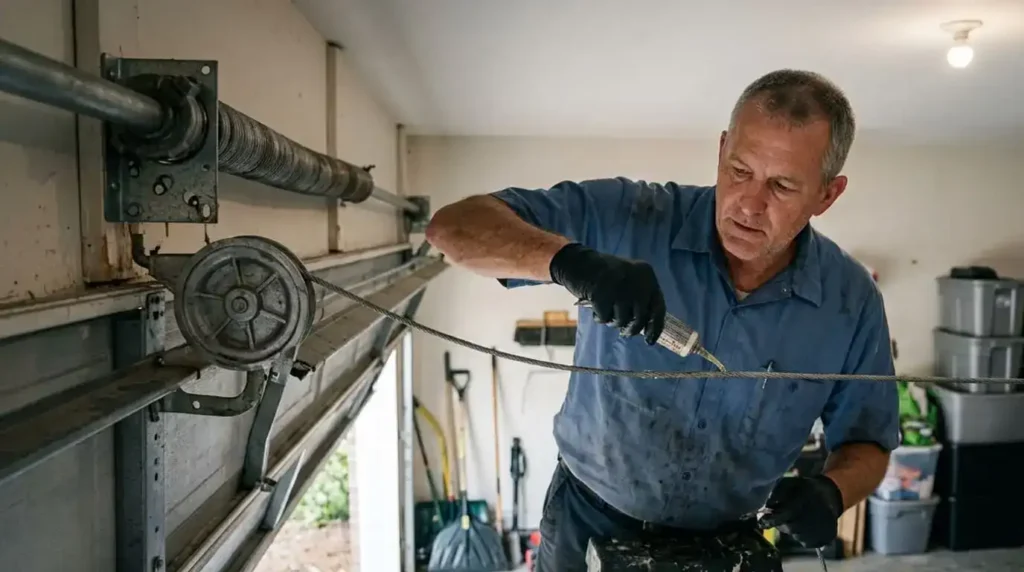
Under typical residential use and with periodic lubrication, galvanized steel lift cables last between eight and twelve years in most Nashville area garages. High usage households that cycle the garage door eight to ten times daily see cable wear accumulate faster, sometimes bringing the practical service life closer to six to eight years.
Nashville’s humidity and temperature cycling tends to pull that lifespan toward the shorter end of those ranges in garages that are not maintained. Garages that are regularly lubricated and inspected tend to see cables reach the longer end of those ranges even with heavy use.
If your cables are approaching eight years old and have never been inspected, that conversation is overdue. The cost of a proactive inspection is a fraction of the cost of an emergency cable replacement plus the secondary damage that can occur when a cable snaps without warning.
Get Your Cables Inspected or Replaced Today in Nashville
If you recognized any of these warning signs on your own door, or if you simply cannot remember the last time anyone looked at your cables, now is the right time to do something about it rather than waiting for the door to force the issue on a morning you can least afford it.
Our Garage Door Repair in Nashville team serves all of Davidson County and the surrounding Middle Tennessee area with same day service and all parts on every truck.
We carry galvanized lift cables in all standard residential gauges, bottom brackets, cable drums, and all associated hardware so your repair is completed in a single visit with no follow up trips. Call (615) 706-3471 right now to speak with a real person and get scheduled. Upfront pricing confirmed before any work begins. No hidden fees. No pressure. One call, one visit, done right.