Torsion Spring vs Extension Spring: Which Does Your Garage Door Use in Smyrna TN?
Most homes in Smyrna, Tennessee run on one of two spring systems, and the difference matters a lot more than people realize. If your garage door was installed or replaced in the last ten years, it almost certainly has a torsion spring sitting on a steel shaft directly above the door opening.
Older homes and single car garages with tighter ceilings tend to have extension springs running along the sides of the tracks instead.
Both systems counterbalance the weight of the door so it opens without burning out your opener motor, but they work in completely different ways and one is significantly safer and longer lasting than the other.
This guide walks you through exactly which system you have, how each one works, and what Smyrna homeowners need to know before a spring failure catches them off guard. If something is already wrong with your door, call (615) 706-3471 right now. We offer same day service across Smyrna and Rutherford County.
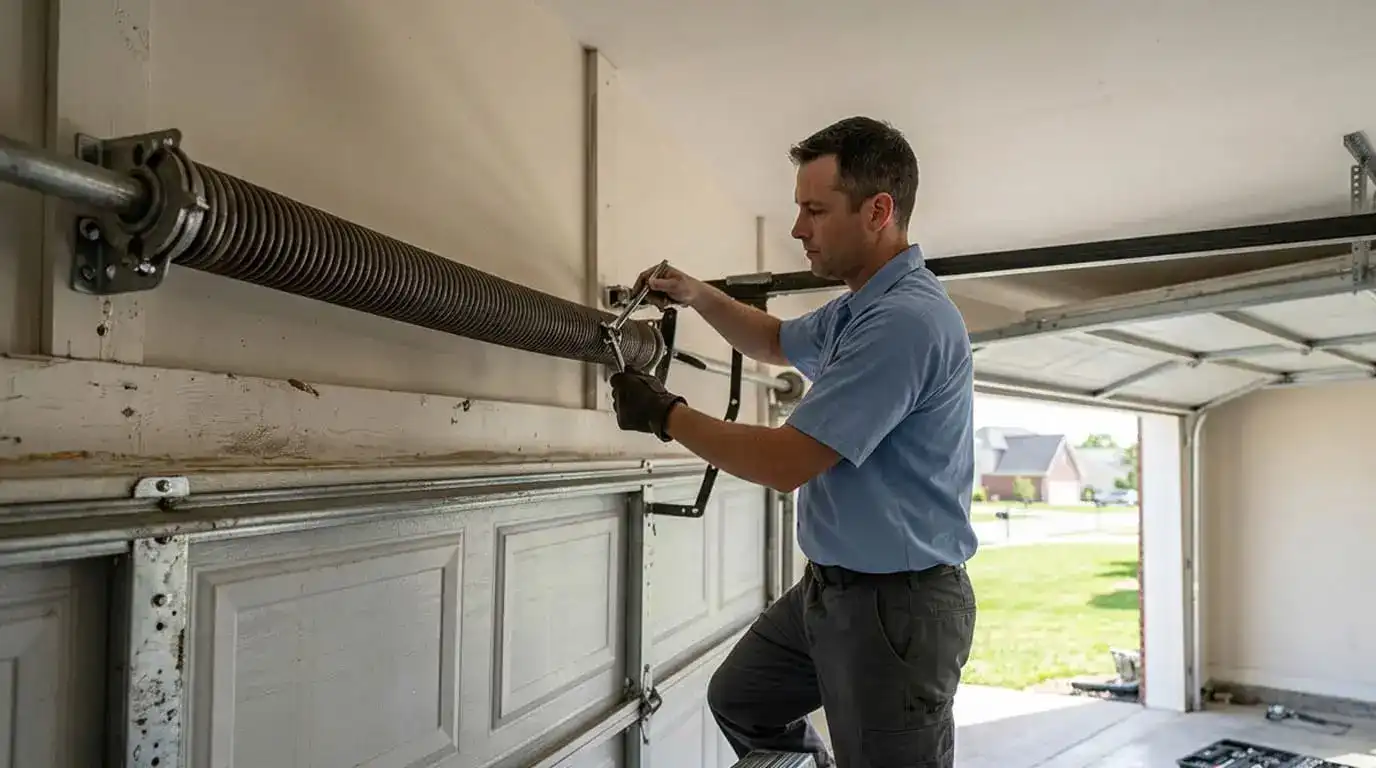
How to Tell Which Spring System You Have
Walk into your garage and look up. The answer is almost always obvious once you know what to look for.
1. Torsion Spring
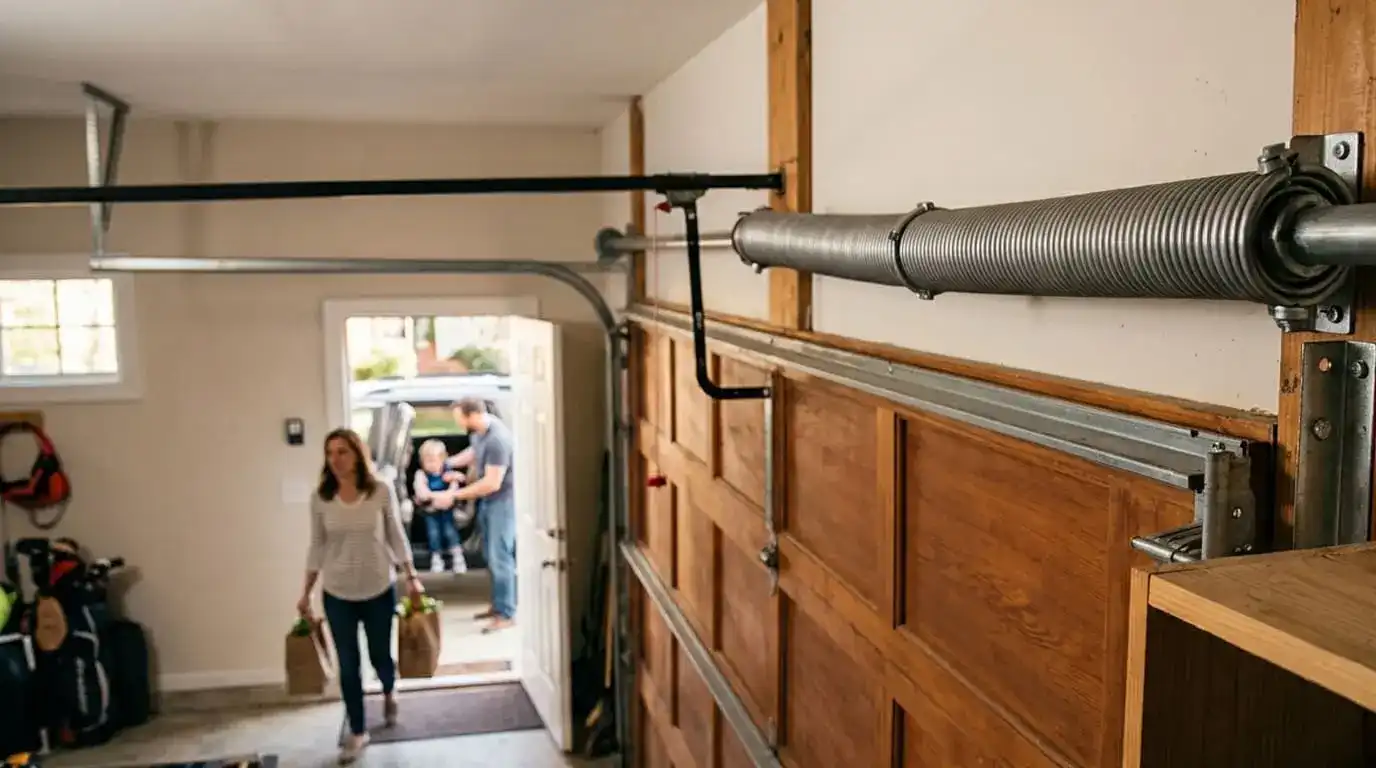
A torsion spring is a thick, tightly wound coil that runs horizontally on a steel shaft above the garage door opening. It spans nearly the full width of the door, and you will see cable drums on both ends of that shaft.
Two car garages often have two springs side by side on the same bar, sometimes with red markings on one side and black on the other to indicate winding direction. The spring itself barely moves during operation because all the action happens internally through rotation.
2. Extension Spring
Extension springs are mounted on either side of the door, running parallel to the horizontal tracks along the left and right walls of your garage. They are longer and thinner than torsion springs, and you can visually see them stretch and contract as the door moves.
Most properly installed systems have a safety cable threaded through the center of each spring to catch it if it breaks. If yours do not have those safety cables, that is already worth a conversation with a technician.
How Each System Actually Works
1. Torsion Springs
Torsion springs store energy through torque, which is a rotational twisting force. As the door closes, the spring winds tighter around the shaft and stores mechanical energy.
When the opener activates, the spring unwinds and that energy transfers through cable drums and lift cables to raise the door. Because the force distributes evenly across a single shaft spanning the full door width, the lift is smooth and balanced on both sides simultaneously.
That controlled motion reduces stress on your panels, tracks, rollers, and opener motor over time.
2. Extension Springs
Extension springs operate purely on tension. Each spring stretches as the door closes, storing energy, then contracts as the door opens, pulling on cables that route through a pulley system.
Because there are two independent springs, one on each side, the system involves more hardware overall including pulleys, safety cables, and longer lift cables. If one spring loses tension faster than the other, the door can start pulling unevenly, which creates alignment problems and accelerates wear on the track hardware.
Have questions about what you are looking at? Call (615) 706-3471 and describe what you see. We can usually identify your system in under a minute.
Torsion vs Extension Springs: A Real Comparison for Smyrna Homeowners
1. Lifespan and Cycle Rating
This is where torsion springs pull ahead most clearly. A standard residential torsion spring is rated between 15,000 and 20,000 cycles, where one cycle equals one full open and one full close. For a household that uses the garage door four times a day, a 15,000 cycle spring lasts roughly ten years.
Extension springs are typically rated between 7,000 and 10,000 cycles, which works out to five to seven years under the same usage. For Smyrna families running in and out constantly, that gap in replacement frequency adds up to real money over time.
2. Safety
Torsion springs are the safer option, and the reason is straightforward. When a torsion spring breaks, it stays on the shaft. You will hear a loud bang and the door will stop working, but the broken coil stays contained on the steel tube.
Extension springs behave differently. Without a properly installed safety cable running through the center, a snapped extension spring can launch across the garage with serious force.
There are real cases of broken extension springs going through windshields and windows. Even with safety cables installed, a failed extension spring puts more sudden stress on the remaining hardware in ways a torsion failure typically does not.
3. Operation Quality
If your garage door ever felt like it jumped up fast at the bottom and then slowed near the top, that is the uneven tension pattern extension springs produce. They apply maximum force at the start of the lift and progressively less as they contract.
Torsion springs deliver consistent rotational force throughout the entire travel range, which means the door moves at a steady, controlled pace from bottom to top. For automatic openers, that steadier load directly reduces wear on the motor and drive mechanism.
4. Cost Over Time
Extension springs cost less upfront because the hardware itself is simpler. But that calculation shifts when you factor in shorter lifespan, more frequent replacements, and more components to service on each visit. Most homeowners who compare the full cost over a ten year window find that torsion springs come out ahead, even before accounting for the safety difference.
5. Which Homes Use Which System
Newer neighborhoods throughout Smyrna and Murfreesboro almost universally have torsion spring systems. The industry shifted toward torsion as the standard in recent decades because of the durability and safety advantages.
Older homes, particularly those with single car garages or limited overhead clearance, often still have extension springs because those doors were originally designed with tighter ceiling constraints.
Torsion systems require enough headroom above the door to mount the shaft assembly properly, so there are still situations where extension springs make practical sense without structural changes.
When a Spring Breaks: What to Expect and What to Do
Warning Signs Your Spring Is Failing
A broken spring usually announces itself with a loud bang. Most homeowners describe it sounding like a firecracker going off inside the garage, after which the door becomes impossible to lift or the opener runs without moving the door more than a few inches.
Warning signs before a full break include a door that feels unusually heavy when lifted by hand, a door that will not stay open at the halfway point, visible gaps in a torsion spring coil, rust or corrosion forming on the spring metal, or a door that drifts to one side during operation.
Why This Is Not a DIY Repair
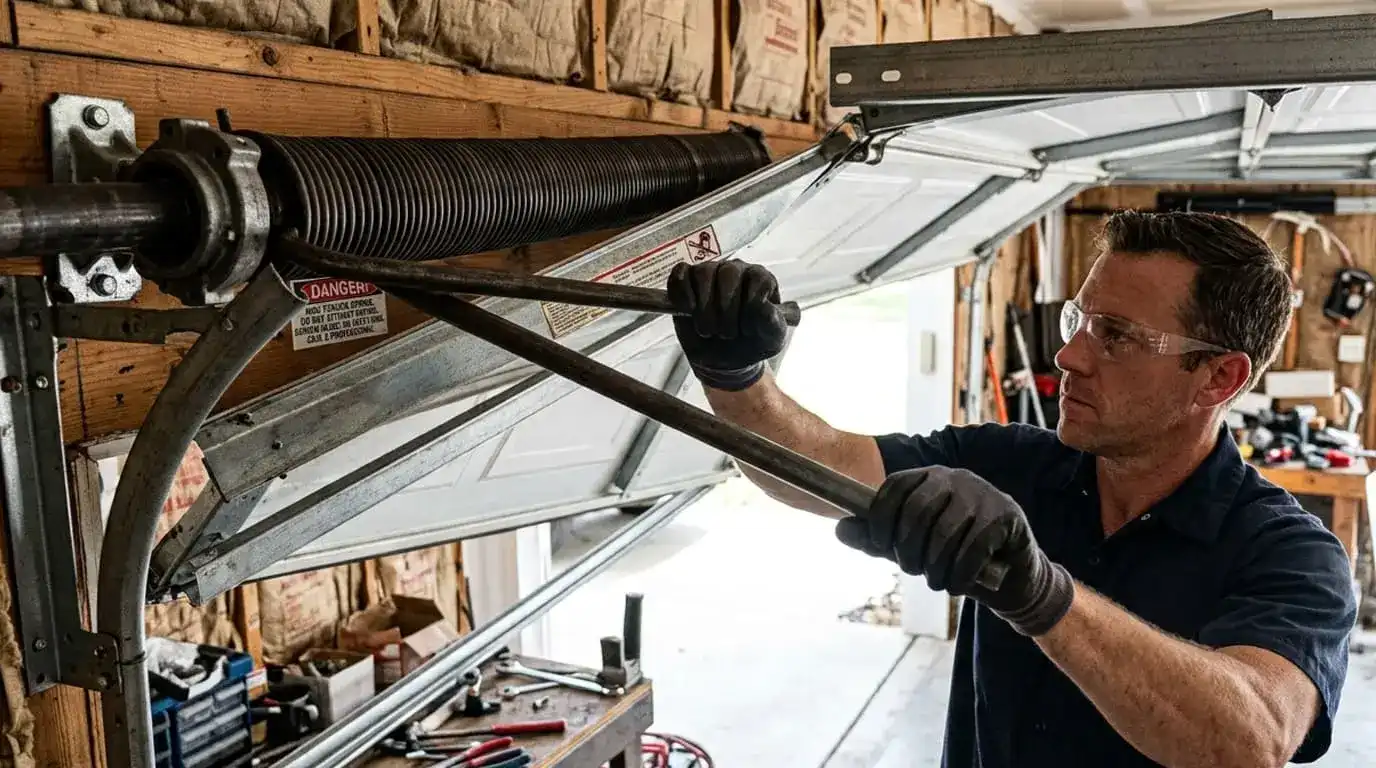
Garage door spring replacement carries real risk and this is not a disclaimer. It is practical physics. A fully wound torsion spring stores a substantial amount of mechanical energy, and releasing it incorrectly causes injury.
The job requires specific winding bars, the ability to calculate the correct spring specifications for the door weight, and hands-on experience with the actual process. Extension springs carry similar hazards.
The volume of emergency room visits each year from amateur spring repairs is not a small number. This is one of those jobs where calling a professional is simply the right call. If your spring is broken or behaving strangely, Call (615) 706-3471) and we will have a technician at your Smyrna home the same day.
Should You Convert From Extension Springs to Torsion?
If your Smyrna home still has extension springs and you are already facing a repair, this is a reasonable time to consider a full conversion.
The process involves removing the extension spring assembly including springs, pulleys, and cables, then installing a torsion bar, drums, and new lift cables. It is not a small job, but the outcome is a safer, quieter, longer lasting system that will reduce your total repair calls over the next decade.
A conversion makes the most sense when your garage has adequate headroom, when you are already investing in a spring repair anyway, or when you have had the same extension spring fail more than once on the same door.
Some garages with very low ceilings are not compatible with a standard torsion conversion, though rear mount and low headroom torsion options exist for tighter spaces.
Our team handling Garage Door Repair in Smyrna can assess your specific setup and give you a straight answer on whether conversion is the smarter investment or whether replacing your current extension springs is the right move given your door dimensions and budget.
Spring Maintenance That Actually Extends Service Life
A few consistent habits can meaningfully add years to your spring system and prevent unexpected failures.
Lubrication
Coat your springs with a lithium based garage door lubricant two to four times per year. On torsion systems, focus on the coils themselves along with the cable drums and bearings.
On extension systems, lubricate along the full length of each spring and give attention to the pulleys and rollers. Avoid WD-40 entirely. It is a solvent that strips existing lubrication rather than adding it, and it leaves the metal more exposed to moisture over time.
Balance Testing
Pull the red release cord on your opener to disconnect it, then lift the door manually to about waist height and let go. A properly balanced door holds its position or drifts down very slowly.
If it drops fast or shoots upward, the spring tension is off and a technician needs to inspect the system before the imbalance causes premature wear on your opener motor and cables.
Visual Inspection
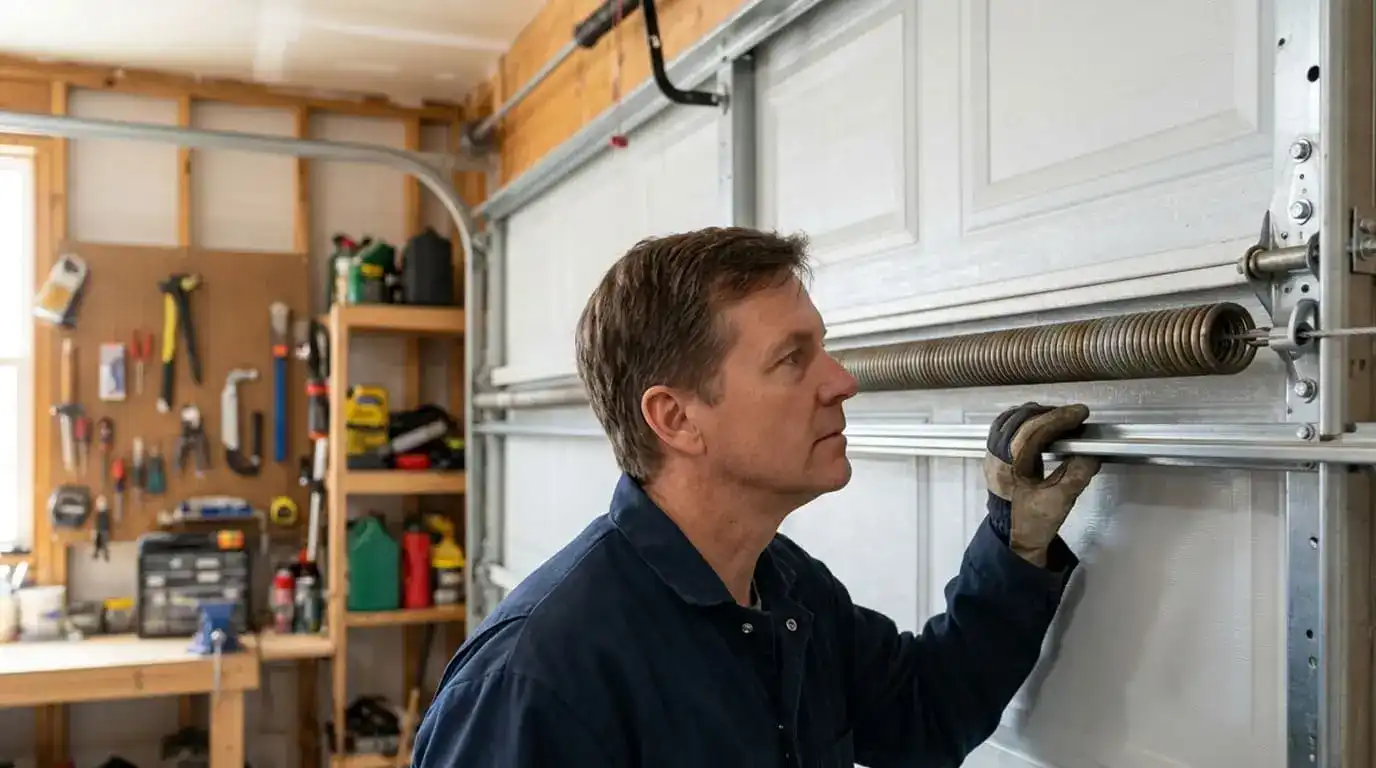
Take thirty seconds every couple of months to look at your springs while the door is closed. On torsion springs, look for visible gaps between the coils or any surface rust forming.
On extension springs, watch for deformation in the coil shape or fraying at the connection points. Catching either of those early is the difference between a simple adjustment and a full emergency replacement at the worst possible time.
For routine maintenance or anything that looks off, our Professional Spring Repair Service team is available at (615) 706-3471 and we cover all of Smyrna and the surrounding Rutherford County area.
Spring Sizing Matters More Than Most People Realize
Not all springs are built the same, and installing the wrong size is a common mistake that causes early failure and poor performance. Torsion springs are specified by wire gauge, inside diameter, and length.
Those three variables together determine how much torque the spring generates, which must match the actual weight of the door being lifted. A spring rated too light for the door breaks ahead of schedule.
One rated too heavy causes the door to open too fast and strains the opener and cables. Extension springs are sized by the amount of force they generate per inch of stretch, which also needs to match the door weight and the geometry of the pulley system. Generic springs from big box stores often come in a few broad sizes, and while they may fit physically, they are frequently the wrong tension rating for the specific door.
That mismatch is a leading reason some doors seem to cycle through spring replacements every two or three years instead of every decade.
When we replace a spring on a Smyrna door, we measure and verify the correct specifications on site before installing anything. That step is what separates a long lasting repair from one that fails again well ahead of schedule.
Get Your Garage Door Spring Fixed in Smyrna TN Today
Whether your torsion spring snapped overnight, your extension spring has been pulling unevenly for weeks, or your door just does not feel right, our team is ready to help. We serve Smyrna, LaVergne, Murfreesboro, and all of Rutherford County with same day appointments on most calls. Call (615) 706-3471) right now to speak with a real person and get scheduled. Our trucks carry torsion springs, extension springs, and all the hardware needed so your repair gets done in a single visit.