Signs Your Garage Door Spring Is About to Break in La Vergne TN
Most garage door springs do not snap without warning. They give signals for days, sometimes weeks, before they finally give out. The problem is most La Vergne homeowners do not know what those signals look like until they are already standing in the garage staring at a door that will not open and a car they cannot get out. These are the garage door spring warning signs La Vergne TN homeowners need to know right now, before a full break catches them off guard on a Monday morning when they are already running late.
Read through all of them because some are obvious and some are so easy to miss that most people drive past them for months. If something on this list already sounds familiar, do not wait. Call (615) 706-3471) right now and we will get a technician to your La Vergne home the same day.
What a Garage Door Spring Actually Does
Before the warning signs make sense, it helps to understand what the spring is doing every single time the door moves. Your garage door weighs anywhere from 100 to 300 pounds depending on the size and material. Without a spring, your opener motor could not lift it, and you definitely could not lift it by hand without serious effort.
The spring does the heavy work. It stores mechanical energy when the door closes and releases that energy when the door opens, counterbalancing the weight so the door feels almost weightless during operation. When a spring starts losing tension or developing cracks in the metal, that counterbalance starts to fail.
The opener works harder. The door moves differently. Things start to feel and sound wrong. Those changes are the warning signs, and catching them early is the difference between a planned repair and an emergency.
Warning Sign 1: The Door Feels Heavier Than It Used To
This is the most reliable early signal and the easiest one to test right now. Pull the red release cord hanging from your opener to disconnect it. Now lift the door by hand to about waist height and let go. A healthy spring system means the door should feel almost weightless, like you are barely doing anything, and it should hold that position or drift down very slowly when you release it.
If the door feels noticeably heavy when you lift it, or if it drops fast the moment you let go, your springs have lost tension. They are no longer doing their share of the counterbalance work. The opener has been quietly compensating for this for a while, working harder on every single cycle to make up for what the spring is not providing anymore.
That extra strain is burning through your opener motor at the same time. This test takes sixty seconds. If the door feels wrong, it is wrong. Call (615) 706-3471) and describe what you noticed.
Warning Sign 2: You Hear a Loud Bang From the Garage
If you are sitting in the house and you hear what sounds like a gunshot or a firecracker going off in the garage, go check your torsion spring. That sound almost always means a spring has already snapped. A torsion spring stores a large amount of rotational energy while it is wound. When the coil breaks, that energy releases instantly all at once, creating a sharp bang loud enough to hear through walls.
After the sound, the door will either refuse to open at all or the opener will run but the door will barely move, maybe three to four inches off the ground before it stalls. If this has already happened to you, do not keep trying to operate the door. Do not use the opener.
Running the motor against a door with no spring support can burn it out in a single attempt, turning a spring replacement into a spring plus opener replacement on the same bill. Leave the door where it is and Call (615) 706-3471 for same day service.
Warning Sign 3: You Can See a Gap in the Spring Coil
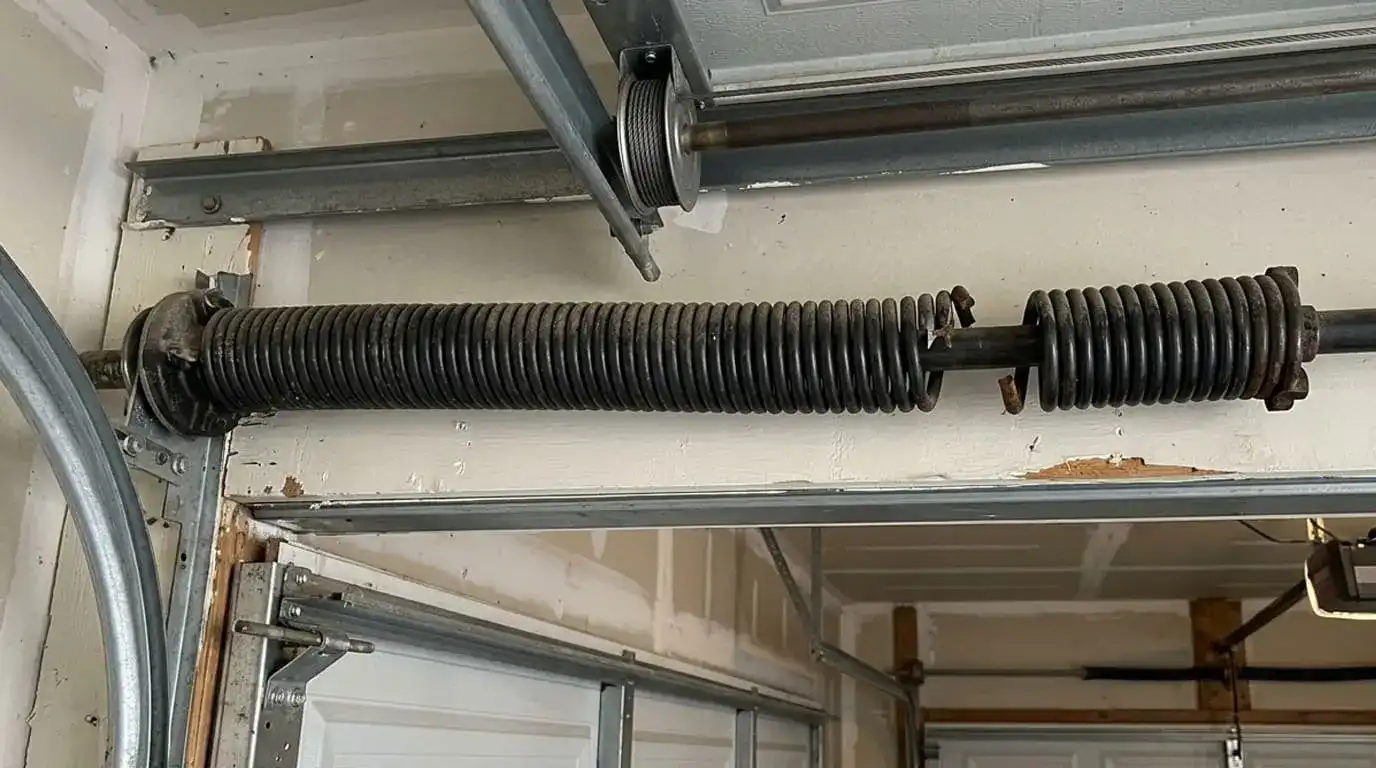
Walk into your garage and look up at the torsion spring mounted horizontally above the door opening. A healthy spring has evenly spaced coils with no separation between them. If you see a visible gap, a space where two coils have pulled apart from each other, the spring has already partially or fully broken.
This gap appears because the metal has fractured at that point and the coil has separated under the tension it was holding. The spring is no longer intact and it cannot provide the counterbalance the door needs. A door running on a spring with a visible coil gap is one cycle away from a complete failure at any moment.
This is not a schedule it for next week situation. A spring showing a coil gap needs to come out today. The longer the door operates in that condition, the greater the risk of the door dropping unexpectedly or the opener motor burning out from the overload.
Warning Sign 4: The Door Moves Unevenly or Tilts to One Side
Watch your door the next time it opens. It should rise smoothly and evenly from both corners at the same rate. If it looks like one side is coming up faster than the other, or if the door appears slightly tilted when it is partially open, one spring is weaker than the other. On a two spring torsion system, this means one coil has lost more tension than its counterpart.
The stronger spring pulls its side of the door faster, creating a visible asymmetry during travel. That uneven pull puts asymmetric stress on the tracks, the rollers, and the cables. Over time, a door that has been running out of balance will develop roller wear, track misalignment, and cable problems that all show up on the same repair visit as the spring, making the total bill significantly higher than it would have been if the spring imbalance had been caught earlier. If your door in La Vergne is tilting even slightly during operation, get it looked at before the asymmetry causes damage to surrounding hardware.
Warning Sign 5: New Squeaking, Grinding, or Popping Sounds During Operation
A garage door that has been quiet for years and suddenly starts making new noises is telling you something has changed inside the mechanical system. Squeaking from the spring area usually means the coils are dry and starting to develop surface rust. In La Vergne and across Rutherford County, the humid Tennessee climate accelerates oxidation on unlubricated spring steel faster than homeowners expect.
A spring that squeaks every time the door moves has metal surfaces rubbing against each other without lubrication, which accelerates wear and shortens the remaining service life. Grinding sounds indicate that the spring coils or the hardware they interact with are experiencing metal on metal contact that should not be happening.
This points to either misalignment or deformation in the spring geometry. Popping sounds during operation are the most concerning. A torsion spring that produces a popping or ticking sound as the door moves is showing signs of internal metal fatigue, tiny fractures forming inside the coil that produce sound as they flex under load.
This is a spring that is approaching the end of its structural integrity, and it is giving you a warning you should not ignore. Lubrication with a white lithium based garage door lubricant resolves early squeaking. Grinding and popping require a technician’s inspection because those sounds typically indicate damage rather than just dryness.
Warning Sign 6: The Opener Struggles or Strains to Lift the Door
Your garage door opener was designed and calibrated to lift a door that is properly counterbalanced by a healthy spring. When the spring weakens, the opener picks up the difference. At first this is subtle, maybe a slight slowing during the lift, or a soft strain in the motor sound that was not there before. As the spring continues to lose tension, the opener strain becomes more obvious.
The door might move slower than it used to. The motor might sound like it is working harder. In some cases, the opener’s built in overload protection triggers and the door reverses before it fully opens, because the motor detects it is pulling more weight than it should be.
Homeowners in this situation often assume the opener is failing and shop for a new motor, when the actual problem is a spring that needs to be replaced. If your opener is a major brand like LiftMaster, Chamberlain, or Craftsman and it has been working fine for years but recently started struggling, check your spring tension before you assume the opener is the problem.
Warning Sign 7: Visible Rust or Surface Pitting on the Spring
Look at your spring coils with the door in the closed position. A surface coat of light dust or a faint brownish tint that wipes away with a cloth and some lubricant is manageable and common in Tennessee’s humid climate. What is not manageable is rust that has pitted into the coil surface, creating small craters or rough patches in the metal.
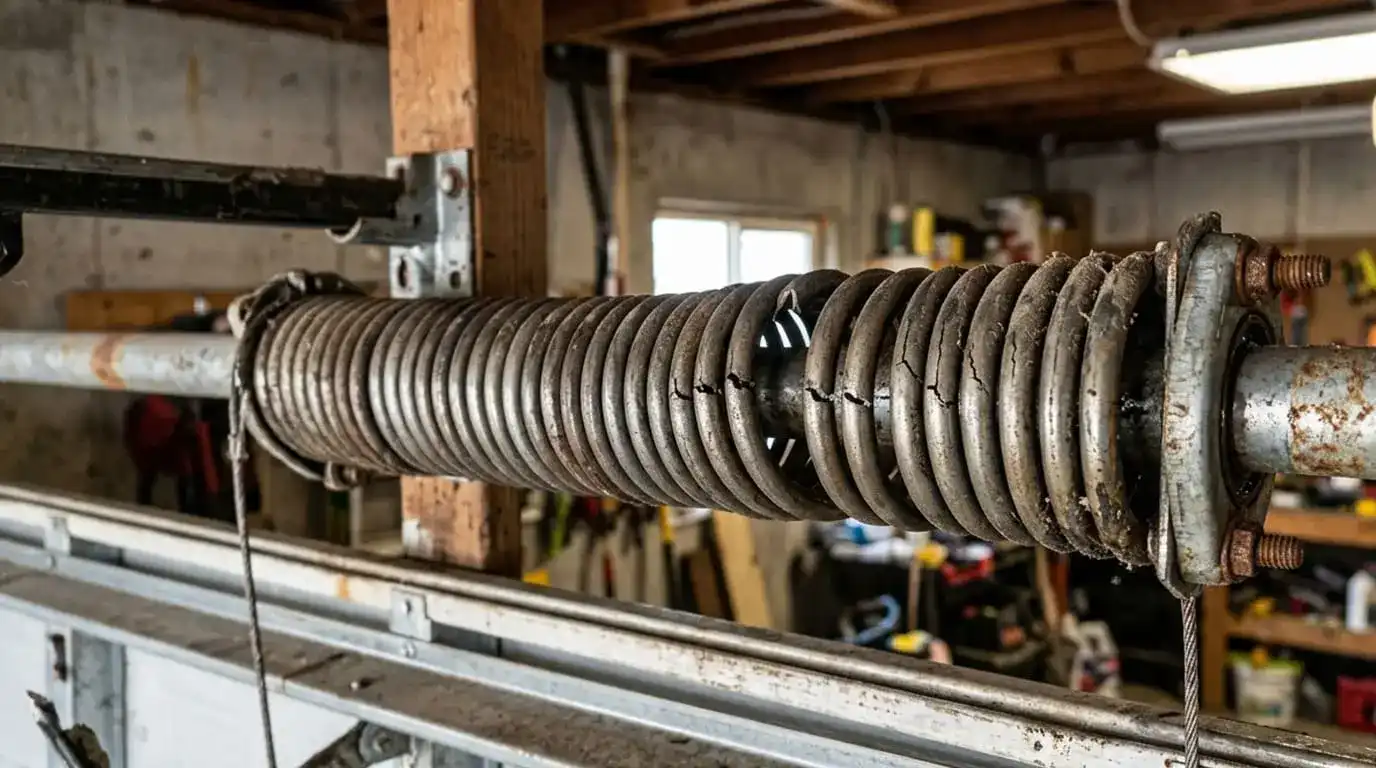
Pitting means the oxidation has eaten past the surface layer into the structural steel of the coil. At those pitted points, the metal cross section is thinner than it was designed to be, and the spring cannot handle the same load it was rated for when it was new.
A pitted torsion spring may still operate the door for a while, but the weakened points are where fractures initiate, and the spring will eventually break at one of those spots without additional warning. If you see rust pitting on your spring coils in La Vergne, that spring needs replacing. How soon depends on the severity, which a technician can assess on site in a few minutes.
Warning Sign 8: The Door Slams Shut Instead of Closing Smoothly
The spring does not just help open the door. It also controls the speed at which the door descends when closing. A healthy spring provides resistance during the closing cycle, slowing the door’s descent so it settles gently onto the ground rather than slamming down. When a spring has lost significant tension, that closing resistance weakens or disappears.
The door drops faster than it should, sometimes significantly faster. If your garage door has recently started closing faster than you remember, or if it makes a solid thud when it hits the ground rather than a soft landing, the springs are not providing the closing resistance they should be. This is not just an operational nuisance.
A door that closes too fast poses a real safety risk to anyone or anything in the path of the descent, including children, pets, and vehicles. The auto reverse sensors on your opener help, but they are designed to detect obstructions at the bottom of travel, not to compensate for a door that is descending too fast throughout the full closing arc.
What Happens to La Vergne Homes Specifically
La Vergne sits in Rutherford County at an elevation and position in Middle Tennessee that puts it directly in the path of the temperature and humidity patterns that are hardest on spring steel. Summers bring sustained heat and high relative humidity. Winters bring sharp cold snaps that arrive fast and drop temperatures significantly overnight.
That thermal cycling, warm and humid in summer, cold and dry in winter, puts stress on spring steel through a mechanism called thermal fatigue. Every significant temperature change causes the metal to expand and contract slightly. Over years and thousands of cycles layered on top of that thermal movement, microscopic stress points accumulate in the coil metal that are not visible from the outside but reduce the spring’s structural integrity below its rated capacity.
This is why springs in La Vergne and across Rutherford County sometimes fail earlier than the national average cycle ratings suggest. The cycle rating assumes controlled temperature conditions. Tennessee’s actual climate is not controlled, and the springs in unventilated attached garages in La Vergne feel every seasonal shift in full.
How to Check Your Springs Right Now in Under Two Minutes
You do not need tools or technical knowledge for this. Just a couple of minutes and your eyes. First, disconnect the opener by pulling the red release cord and lift the door manually to waist height. Let go and see what happens. It should hold position or drift very slowly downward. If it drops fast or feels heavy, your spring tension is low.
Second, look directly at the torsion spring above the door opening while the door is in the closed position. Look for any visible gap between coils, any rust or pitting on the coil surface, or any deformation where the spring looks uneven or bent. On extension springs, look along both sides of the door for any deformation in the coil shape or fraying where the spring meets the cable.
Third, cycle the door once with the opener reconnected and listen. New squeaking, grinding, or popping that was not there three months ago is worth calling about. If anything in that two minute check concerns you, our Garage Door Repair in La Vergne team is available at (615) 706-3471 for same day service.
Why Waiting Makes It More Expensive
Every day a failing spring operates the door, more components absorb the stress the spring is not handling properly. The opener motor works harder. The cables wind unevenly on the drum. The rollers wear faster because the door is heavier in the track. The track brackets take more lateral load. By the time a failing spring finally breaks completely, it has frequently already shortened the service life of two or three other components that were never designed to compensate for it.
What starts as a spring replacement call can expand to include cables, drums, and opener motor work depending on how long the failing spring was left in service. Catching a spring at the warning sign stage, before it breaks, is always the lower total cost path. It also gives you control over the timing rather than having the spring choose the moment, which is usually the worst possible one.
The Right Way to Add Years to Your Spring Life
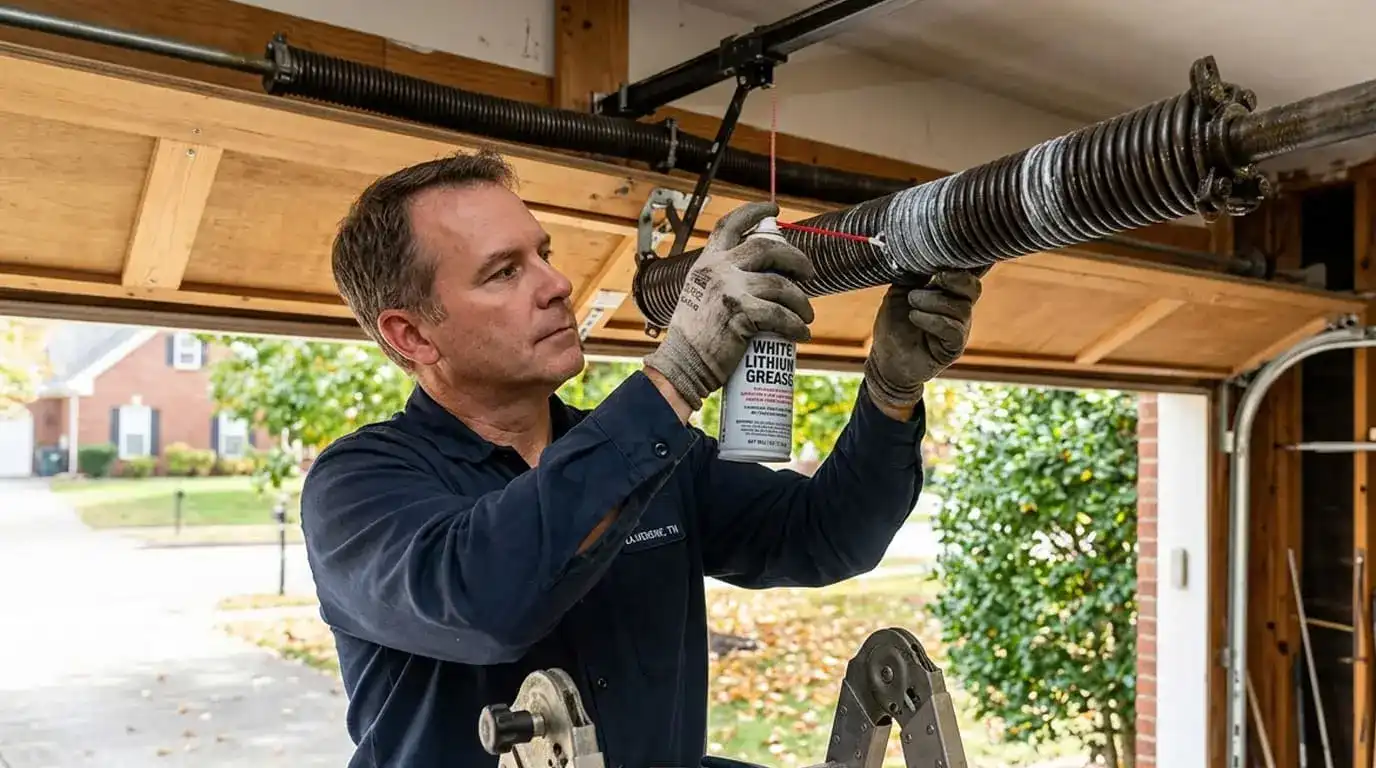
Maintaining your springs properly is not complicated, and doing it consistently is the difference between a spring that reaches its full rated cycle life and one that fails two or three years early. Lubricate the spring coils with a white lithium based garage door lubricant two to four times per year. Spring, summer, fall, and just before the coldest months of the year is a good schedule for La Vergne’s climate.
This keeps the metal coils from developing the surface rust that leads to pitting, reduces friction at every point in the operating cycle, and lets you see clearly when something has changed in the spring’s appearance since the last application. Do the balance test every six months. Disconnect the opener and lift the door to waist height.
If it holds, your spring tension is still adequate. If it drops, call before the spring finishes failing on its own schedule. Ask about a Preventive Maintenance Plan on your next service visit. A scheduled annual inspection by a qualified technician covers all of this and surfaces small issues before they become broken spring emergencies.
Get Your Springs Inspected Today in La Vergne TN
If you recognized any of these warning signs on your own door, the right move is a same day inspection before the spring decides the rest of the timeline on its own. We serve La Vergne, Smyrna, Murfreesboro, and all of Rutherford County with same day service and full transparency on pricing before any work starts.
Call (615) 706-3471 right now. A real person picks up, we walk through what you are seeing, and we get a technician to your La Vergne home the same day. Every truck carries the springs, cables, and hardware needed to complete the repair in a single visit.